Imagine this: You have a flash sale starting in one hour. You fire off an SMS blast to your entire customer list-50,000 people. Within minutes, the open rates roll in. Looks good. SMS is reliable that way. But the conversions? Barely a trickle.
Now imagine a different scene.
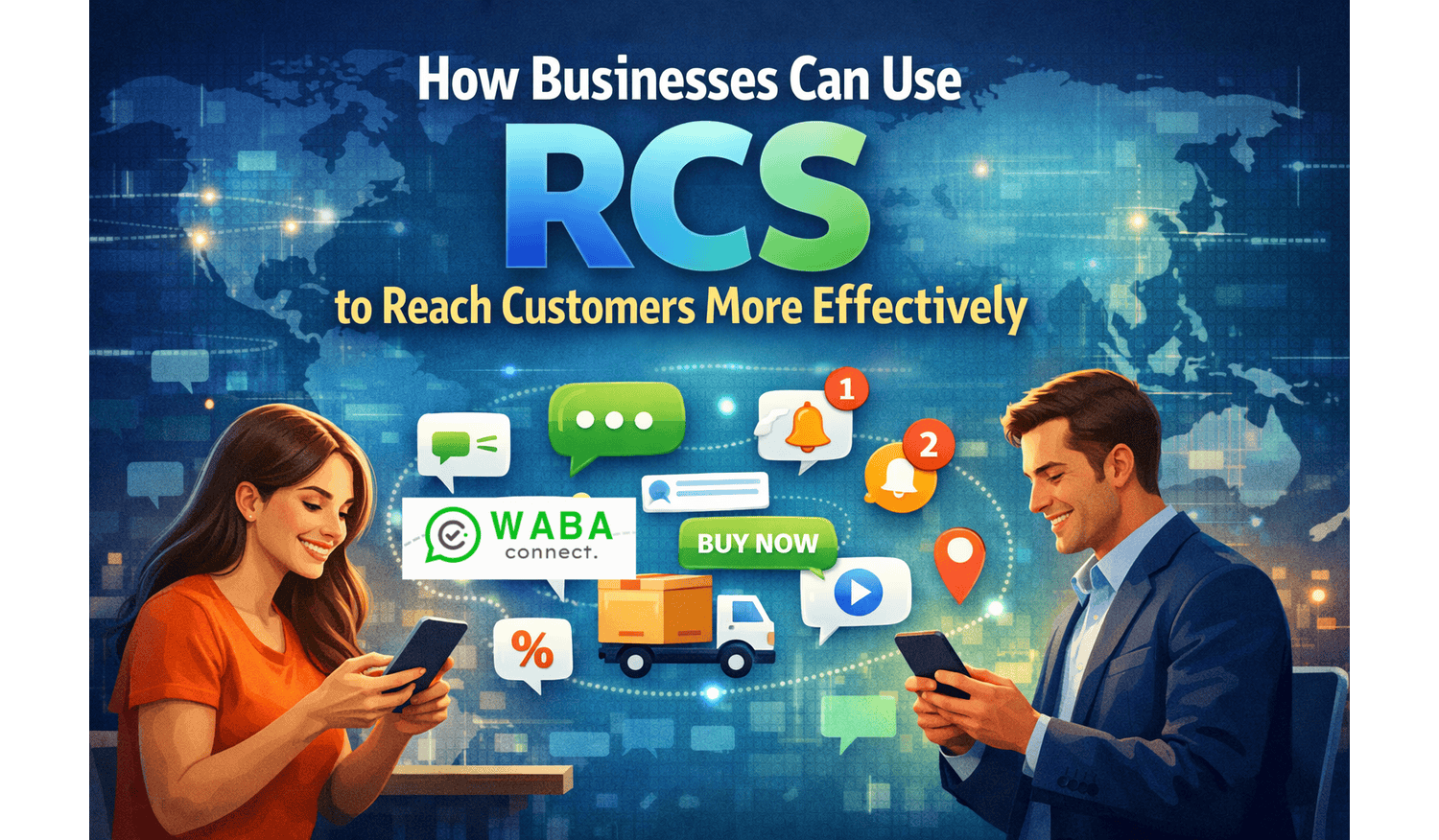
A customer receives a message, but it doesn’t come from a random 10-digit number. It arrives with your company logo, your verified brand name, and a swipeable carousel of the actual products on sale. Below the images, there are buttons: “Shop Men,” “Shop Women,” “View Cart.” The customer taps, browses, and buys-all without ever leaving their messaging app.
This isn’t a beta test or a futuristic concept. This is RCS Business Messaging, and in 2026, it has become the gold standard for brands that actually want to connect, not just broadcast.
According to the GSMA’s 2026 Mobile Economy Report, 96% of Android devices globally now support Rich Communication Services (RCS) , and with Apple’s iOS 18 update bringing RCS support to iPhones, the fragmentation that once held this channel back has all but disappeared .
Yet here’s the staggering gap: while the technology is ready, Mobilesquared’s 2026 State of Messaging report reveals that 59% of businesses haven’t launched a single RCS campaign . They’re still sending plain text SMS, hoping for different results. Meanwhile, early adopters are seeing 3.5x higher conversion rates and 60% fewer spam complaints .
At WABA Connect, we’ve helped over 2000+ enterprises across India, the Middle East, and Southeast Asia bridge this gap. In this comprehensive guide, we’ll walk you through exactly what RCS is, how it compares to SMS and WhatsApp, and-most importantly-how your business can implement it to drive real, measurable results.
RCS (Rich Communication Services) is the evolution of SMS. Think of it as “SMS 2.0.” It takes the humble text message-which hasn’t changed in decades-and transforms it into an interactive, media-rich experience that lives right inside the phone’s native messaging app.
Technically speaking, RCS Messaging is a protocol designed by the GSMA to replace traditional SMS. But you don’t need to care about the technicalities. What matters is what it does for your customer experience.
When you send an RCS Message to a customer, their phone automatically detects that the message supports rich features. Instead of plain text, they see:
A Real-World Example:
Consider how Indigo Airlines handles boarding passes. Before RCS, you’d get an SMS with a link to download your boarding pass. The link would open a browser, maybe ask you to log in, and then finally show a PDF.
With RCS Messaging, the experience is seamless. The message arrives from “Indigo” (verified logo included). It shows your flight details, a countdown to departure, and a button that says “View Boarding Pass.” You tap it, and the pass appears instantly. No logins. No PDF downloads. No friction.
This is why Forrester Consulting’s 2025 report found that RCS reduces customer effort scores by 40% compared to traditional SMS.
To truly understand where RCS fits, you need to see the landscape. Most businesses today use a mix of SMS and WhatsApp API. RCS isn’t here to replace either-it’s here to fill the massive gap between them.
| Feature | SMS (Traditional) | RCS Messaging (Rich Communication) | WhatsApp Business API |
| Media Support | Plain text only (MMS is costly & limited) | Rich cards, carousels, high-res video | Rich cards, catalogs, video |
| Internet Required | No | Yes (Wi-Fi or mobile data) | Yes |
| Branding | Phone number only | Verified logo & business name | Business profile with verification |
| Interactivity | Links only (often shortened, look spammy) | Buttons, carousels, suggested replies | Buttons, quick replies, catalogs |
| Read Receipts | No | Yes | Yes |
| Delivery Reports | Basic | Detailed engagement analytics | Basic |
| App Requirement | Native (works on every phone) | Native (Android & iOS 18+) | Customer must have WhatsApp installed |
| Character Limit | 160 characters | Unlimited (with rich media) | Unlimited |
| Fallback Option | None | Auto-fallback to SMS when RCS unavailable | None |
| Typical Use Case | OTPs, urgent alerts | Rich notifications, marketing, transactions | Customer service, long conversations |
When to use each channel:
RCS isn’t an either-or decision. It’s an and. Smart businesses are using SMS for reach, RCS for engagement, and WhatsApp for service. The magic happens when you connect them all.” – Neha Sharma, Director of Product Marketing, Sinch (Source: Mobile Messaging Summit 2025)
Let’s get specific about the benefits. These aren’t theoretical-they’re backed by data from enterprises already using RCS at scale.
Plain text is invisible. Our brains are wired to ignore it when scrolling. But images? Videos? Interactive elements? They grab attention.
The Data:
According to Juniper Research’s 2026 RCS Business Messaging report, RCS messages achieve an average click-through rate of 19% , compared to SMS which hovers around 3-5% (when you count link clicks) .
Example:
A fashion retailer sends two campaigns:
The RCS campaign generates 6x more conversions because customers see exactly what they’re getting before they click.
Every extra click is a leak in your funnel. RCS plugs those leaks by bringing the action directly into the message.
Instead of: “Track your order here: [link]”
You get: A button that says “Track Order” that, when tapped, shows real-time tracking updates within the chat.
Instead of: “Book your appointment by calling 1800-XXX-XXXX”
You get: A button that says “Book Now” that opens your booking calendar instantly.
Sinch’s 2026 Mobile Engagement Report found that messages with interactive buttons see 2.8x higher conversion rates than those with links alone .
This might be the single most important benefit.
SMS spoofing-where scammers fake a sender ID to look like your bank-has exploded. In India alone, the Telecom Regulatory Authority (TRAI) reported over 50,000 smishing complaints in 2025 . As a result, consumers are skeptical of every text message they receive.
RCS solves this through rigorous brand verification. Before you can send RCS messages, you must:
Once verified, every message you send displays:
The Result:
Bandwidth’s 2026 State of Messaging Report found that 71% of consumers are more likely to engage with a branded RCS message than an identical SMS from an unknown number .
With SMS, you know if a message was delivered. Maybe. With RCS, you get enterprise-grade analytics:
This data transforms messaging from a “spray and pray” channel into a precision marketing tool.
Theory is helpful, but examples make it real. Here’s how businesses across industries are using RCS today.
Problem: Cart abandonment rates hover around 70% , and standard abandonment emails get ignored. SMS reminders feel spammy and rarely include product visuals.
How RCS Solves It:
An RCS abandoned cart message shows the actual products the customer left behind-images, prices, and all. Below the carousel, buttons offer “Complete Purchase,” “Save for Later,” or “View Similar Items.”
Result:
A leading Indian e-commerce platform (name withheld for confidentiality) implemented this and saw cart recovery rates increase by 22% within three months. Customers reported that “seeing the product reminded me why I wanted it” .
Problem: Fraud alerts and transaction confirmations via SMS look identical to phishing attempts. Customers ignore them, or worse, fall for scams.
How RCS Solves It:
A verified RCS message from HDFC Bank (for example) arrives with the bank’s logo. A high-value transaction triggers an alert with buttons: “Yes, it was me” or “No, block my card.” Tapping “No” immediately freezes the account and connects the customer to fraud prevention.
Result:
ICICI Bank reported (in a 2025 case study) that RCS alerts reduced fraudulent transaction completion by 34% because customers could respond instantly instead of hunting for a phone number to call .
Problem: Missed appointments cost the Indian healthcare system an estimated ₹1,200 crore annually . Patients forget, or the confirmation process is too complicated.
How RCS Solves It:
An Apollo Hospitals RCS reminder includes:
Result:
Apollo’s pilot program saw appointment confirmation rates jump from 58% to 89% , and no-shows dropped by half .
Problem: Travel information is scattered across emails, apps, and SMS. Customers struggle to find their booking details when they need them.
How RCS Solves It:
MakeMyTrip sends a single RCS thread for an entire trip. It includes:
Result:
Customer satisfaction scores increased by 27% , and support ticket volume dropped because travelers could self-serve within the message thread.
India presents a unique opportunity for RCS Business Messaging. With over 650 million Android users-the largest Android base of any country-and aggressive rollout by telecom operators, India has become a global hotspot for RCS adoption .
Why India is RCS-ready:
A leading Indian quick-commerce platform (Zepto-style) faced a challenge: their SMS delivery notifications were being ignored, leading to missed deliveries and customer frustration.
They switched to RCS for delivery updates. The message now includes:
Result: Failed deliveries dropped by 40%, and customer support calls about “where’s my order” decreased by 60%.
If you’re convinced that RCS belongs in your strategy, the next question is: how do you actually implement it?
The process is simpler than you might think, especially with an experienced RCS messaging API provider in India like WABA Connect handling the heavy lifting.
You cannot connect directly to the RCS ecosystem as a business. You need a provider that acts as the bridge between your systems and the telecom operators/Google.
What to look for in a provider:
This is the most critical step. You must prove to Google and the telecom operators that you are who you say you are.
You’ll need to provide:
Timeline: Typically 3-5 business days for verification .
RCS isn’t just about sending pretty pictures. You need to think about the customer journey.
Work with your provider’s creative team (or use their template builder) to design:
Once your brand is verified and templates are approved, it’s time to connect RCS to your existing systems.
Common integrations:
A good provider offers REST APIs with clear documentation and SDKs for popular programming languages.
Not every message will reach an RCS-enabled device. Maybe the customer has an older phone. Maybe they’re in an area with poor data connectivity.
Intelligent fallback automatically detects when RCS isn’t available and sends the message as SMS instead. The customer experience remains seamless-they get the information either way, and you maintain 100% deliverability .
Start with a small segment of your audience. Test:
Once validated, scale up gradually while monitoring performance.
RCS is powerful, but with great power comes great responsibility. Here’s how to use it right.
Just because you can send rich media doesn’t mean you should send a novel. RCS messages should be:
Generic CTAs underperform. Be specific.
| Weak CTA | Strong CTA |
| “Learn More” | “See Today’s Deals” |
| “Shop Now” | “Shop the Summer Collection” |
| “Contact Us” | “Chat with Support” |
RCS supports dynamic content insertion. Use it.
The Data: Personalized RCS messages see 2.3x higher engagement than generic ones (Sinch, 2026) .
RCS lives in the primary inbox-the same place users get personal messages from friends and family. If you spam them, they won’t just ignore you; they’ll block you.
Best practices:
RCS is high-impact, which means it’s also high-risk if overused. A customer might tolerate 5 SMS messages a week, but 5 RCS messages will feel intrusive.
Recommended frequency:
To justify investment and optimize performance, you need to track the right metrics.
Key Metrics to Monitor | ||
Metric | What It Measures | Benchmark (2026) |
Delivery Rate | % of messages successfully delivered | 98-100% (with fallback) |
Read Rate | % of delivered messages that were opened | 90-95% |
Click-Through Rate (CTR) | 15-25% | |
Conversion Rate | % of clicks that completed desired action | Varies by industry |
A telecom company runs an RCS campaign offering a plan upgrade.
ROI Calculation:
This is why businesses are moving budgets from SMS to RCS .
Let’s be honest: RCS isn’t for every message. Here’s how to decide.
 You need to build trust (finance, healthcare, government) Your message benefits from visuals (e-commerce, travel, real estate) You want clear calls-to-action (appointments, bookings, purchases) You need engagement analytics (to optimize campaigns) Your audience is mobile-first (India, Southeast Asia, LatAm)
 You’re sending to feature phones or very old devices You need absolute lowest cost (bulk OTPs) The message is purely informational with no action required You’re messaging in areas with poor data connectivity
The best strategy isn’t choosing one channel-it’s using each where it performs best.
At WABA Connect, we help clients build omnichannel workflows that:
As we move through 2026, several trends are shaping the future of RCS.
1. AI Integration: Imagine an RCS message that isn’t static but conversational. An AI agent lives inside the chat, answering questions, making recommendations, and completing transactions-all without the customer ever leaving the messaging app.
Gartner predicts that by 2027, 80% of enterprise applications will be multimodal-meaning they’ll combine text, voice, and visuals in a single interface . RCS is perfectly positioned to deliver this.
2. Conversational Commerce: The line between messaging and shopping is disappearing. With RCS, customers can:
All in one thread. This is conversational commerce, and it’s growing 3x faster than traditional e-commerce .
3. Deeper iOS Integration: Apple’s adoption of RCS in iOS 18 was a game-changer. While iMessage remains the default for Apple-to-Apple communication, RCS now provides a consistent experience for business messages across both platforms .
Future iOS updates are expected to bring:
4. RCS + 5G: As 5G penetration grows in India (expected to reach 500 million connections by 2027 ), the ability to send high-quality video and interactive content in RCS will become seamless. Think live video support within a chat, or AR try-ons for products .