By 2026, WhatsApp API has become a core communication infrastructure for Indian businesses. It enables companies to manage customer conversations at scale using automation, multiple agents, CRM integrations, and secure messaging. Compared to email, SMS, and the basic WhatsApp Business App, WhatsApp API delivers higher open rates, faster responses, reduced support costs, and a more consistent customer experience across the entire customer lifecycle.
Customer communication has changed more in the last five years than in the previous twenty. Customers today expect businesses to be reachable instantly, respond quickly, and communicate in a human, conversational manner.
Traditional channels struggle to meet these expectations:
WhatsApp is different. It is already the most familiar communication channel for Indian consumers. People use it daily to talk to friends, family, colleagues, and service providers. By 2026, WhatsApp has naturally become the preferred channel for customer-business communication in India.
This shift did not happen because businesses promoted WhatsApp. It happened because customers chose it. For businesses, this means communication strategies must follow customer behaviour. That is why understanding the benefits of WhatsApp Business API is no longer optional. It is essential for growth, efficiency, and customer satisfaction.
WhatsApp Business API is the official, Meta-approved platform that allows businesses to communicate with customers at scale.
Unlike the WhatsApp Business App, which is designed for small teams, the API is built for medium and large businesses that need:
All messages sent through the API follow WhatsApp’s rules on customer consent, template approvals, and encryption-making it suitable for professional and regulated use cases.
In simple terms, WhatsApp Business API turns WhatsApp into a business communication system, not just a chat app.
Most businesses begin with the free WhatsApp Business App because it is easy to use and quick to set up. For small teams and low message volumes, it works well.
However, as customer interactions grow, several limitations appear:
As message volume increases, these limitations slow down response times, confuse teams, and reduce service quality.
As businesses scale, customer communication becomes complex. Multiple departments need access. Customers expect instant replies. Conversations must continue beyond working hours.
At this stage, businesses need a structured communication system, not a consumer messaging app.
WhatsApp Business API is designed for this exact phase of growth. It allows businesses to scale conversations without losing control, compliance, or customer trust.
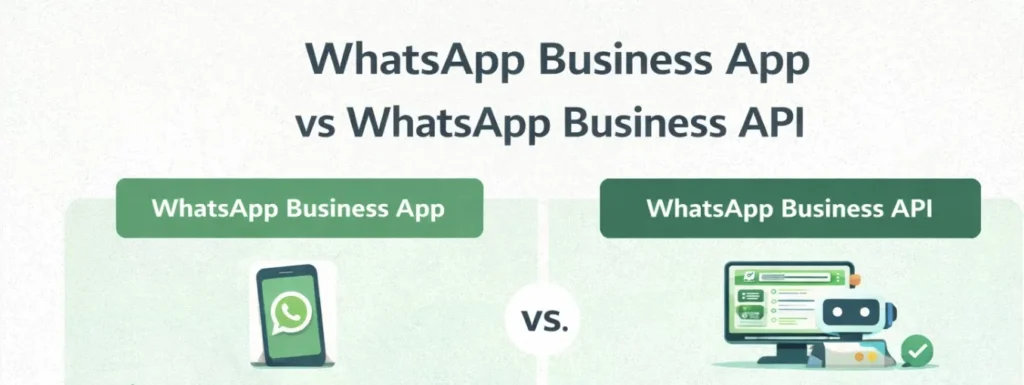
Feature | WhatsApp Business App | WhatsApp Business API |
Best suited for | Small businesses | Growing & large businesses |
Number of users | Very limited | Multiple agents |
Automation | Basic auto-replies | Advanced workflows & chatbots |
Integrations | Not supported | CRM, helpdesk, ERP, payments |
Message volume | Low | High & scalable |
Analytics | Minimal | Detailed reporting |
Verification | Basic profile | Official business verification |
This comparison explains why most growing businesses eventually migrate to WhatsApp API.
One of the biggest problems in business communication is visibility.
WhatsApp messages, however, are usually opened within minutes. Industry data consistently shows 70–80% open rates.
This ensures important messages-such as payment alerts, confirmations, and service updates-are seen, reducing confusion and follow-up calls.
WhatsApp is conversational by design. Unlike email chains that stretch over days, WhatsApp allows real-time interaction.
This is critical for:
Faster conversations lead to quicker decisions, shorter resolution times, and higher customer satisfaction.
Automation works best when it supports customers instead of frustrating them.
WhatsApp API enables automation for:
When automation reaches its limit, a human agent can take over instantly within the same conversation. Customers never feel “handed off” or ignored.
Compared to phone or email support, WhatsApp API allows agents to handle multiple conversations at once.
This leads to:
Over time, businesses reduce support expenses while improving service quality.
WhatsApp supports rich media such as:
These features eliminate long explanations, reduce misunderstandings, and shorten the customer journey from inquiry to resolution or purchase.
WhatsApp API includes:
Customers trust WhatsApp more than unknown SMS senders or emails. This makes the API suitable even for healthcare, fintech, logistics, and emergency services.
The real power of WhatsApp API comes from integrations.
It can connect with:
With WABA Connect, agents see complete customer history in one place, allowing faster, more personalized support without customers repeating themselves.
By 2026, customer communication success depends on being present on the right channel, not every channel.
WhatsApp API is not just a messaging upgrade. It is a long-term infrastructure decision that impacts efficiency, customer experience, and scalability. Businesses that adopt it early gain clarity and control. Those that delay often fall behind quietly.
Choosing the right WhatsApp API platform matters as much as choosing WhatsApp itself. Platforms like WABA Connect ensure automation, compliance, and human support work together seamlessly. WhatsApp API is no longer an experiment. It is infrastructure.
WhatsApp Business API is the official platform by Meta that allows businesses to communicate with customers at scale using automation, approved message templates, multiple agents, and system integrations.
Yes. WhatsApp Business API is legal in India when used through a Meta-approved WhatsApp Business Solution Provider and in compliance with WhatsApp’s opt-in, messaging, and data protection policies.
WhatsApp Business API is a paid service. Pricing is conversation-based and depends on message category, usage volume, and customer interactions.
The WhatsApp Business App is designed for small businesses with limited users and basic features. WhatsApp Business API is built for growing businesses, offering automation, multi-agent access, integrations, analytics, and scalability.
Yes. Small and mid-sized businesses in India often use WhatsApp Business API when message volume increases, automation is required, or multiple team members need access to one WhatsApp number.
Yes. WhatsApp Business API supports full two-way communication, allowing customers to reply, ask questions, and continue conversations with automated systems or human agents.
Yes. Businesses must obtain clear customer opt-in before sending messages using WhatsApp Business API, as required by WhatsApp’s messaging and data protection policies.
Yes. WhatsApp Business API can be integrated with CRM platforms, helpdesk tools, ERP systems, and payment gateways to provide agents with full customer context.
Yes. WhatsApp Business API uses end-to-end encryption and verified business profiles, making it suitable for secure business communication when used according to WhatsApp guidelines.
ENQUIRY NOW
For more information about the WhatsApp Business API solutions we provide, call now. Let’s together unlock the full potential of WhatsApp for your business.
Related articles
info@wabaconnect.com
+91 799 135 8888